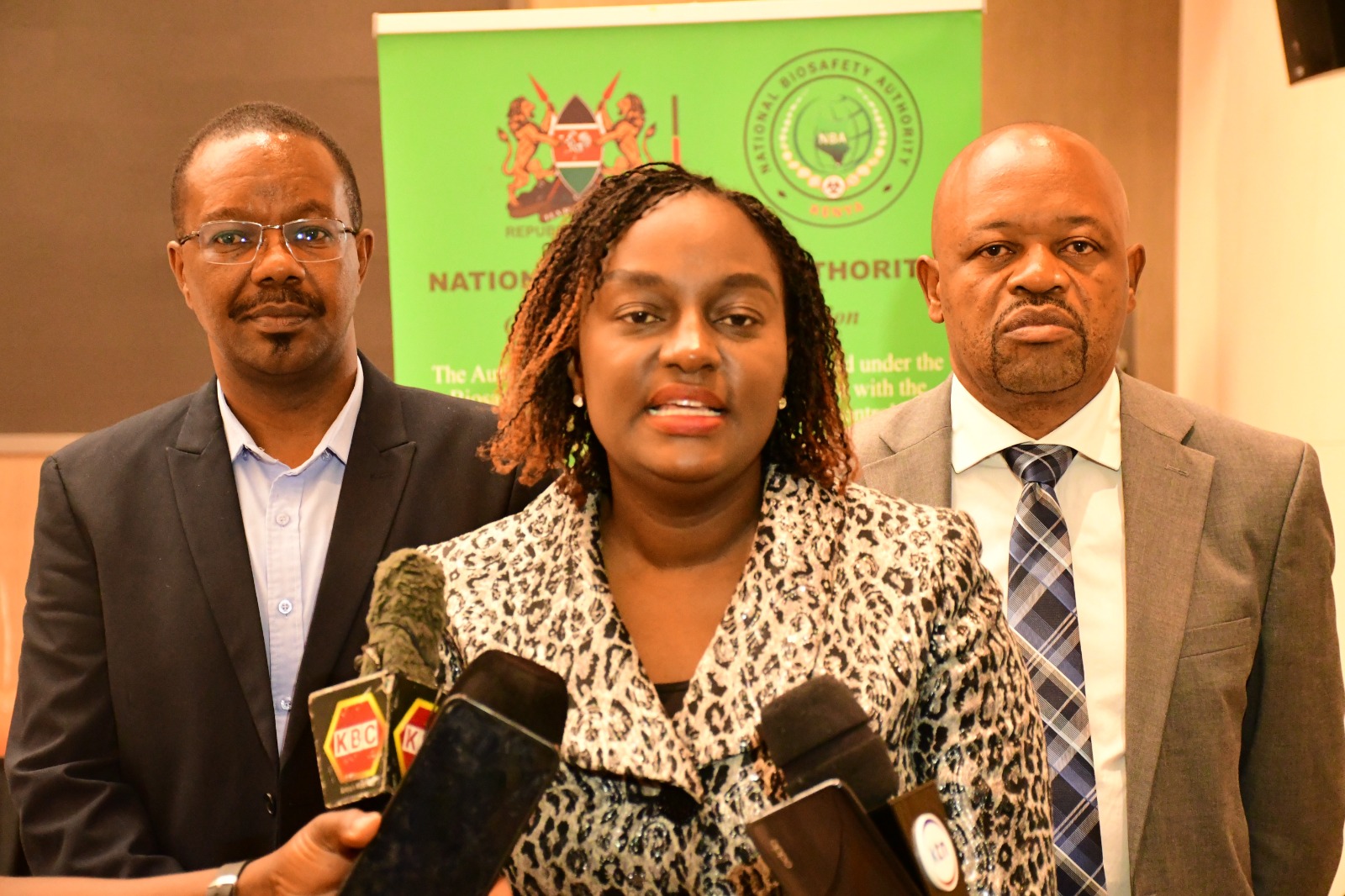
National Biosafety Authority(NBA) acting CEO Dr. Ann Karimi
The National Biosafety Authority (NBA), led by its Chairman, Mr. David Wamatsi, held a consultative engagement with researchers and members of Institutional Biosafety Committees (IBCs) in Nairobi to deliberate on ways of strengthening Kenya’s biosafety framework.
The engagement brought together the Board and key stakeholders in biotechnology research and innovation to discuss opportunities, challenges, emerging trends, and lessons learned in biosafety research and innovation.
Participants also explored practical measures for enhancing Kenya’s biosafety regulatory framework to ensure that it remains responsive to scientific advancements while safeguarding human health, the environment, and other national interests.
In his remarks, Mr. Wamatsi underscored the importance of sustained engagement between the Authority, researchers, and other stakeholders. He noted that such consultations provide an important platform for exchanging knowledge, identifying gaps, and developing practical solutions to emerging biosafety trends.
This engagement provides an important opportunity for the Board to interact directly with those implementing NBA-approved projects, to understand your experiences, challenges and opportunities, and to receive your direct feedback on how we can continuously improve Kenya’s biosafety regulatory framework.
One of the key functions of the Authority under Section 7(2) of the Biosafety Act is to consider and determine GMO applications for contained use, import, export and transit, and environmental release.
Since the establishment of the Authority in 2010, systems have been put in place for receiving applications, undertaking reviews, making decisions and communicating those decisions to applicants.
National Biosafety Authority(NBA) acting CEO Dr. Ann Karimi
He stated that to date, the Authority has approved 46 projects under contained use and laboratory activities, 18 projects under confined field trials, 2 commercial approvals (Bt cotton in 2020 and Bt maize MON 810 in 2022), 3 environmental release applications (Virus resistant cassava, Late blight potato and Bt maize MON 89034), and 9 genome-editing projects.
“These are not merely numbers. They represent significant scientific investment, institutional capacity, partnerships and the commitment of Kenyan and international researchers to address some of the challenges facing our country,” he said.
The approved projects cover important areas including pest and disease management, climate resilience, livestock health and other applications of modern biotechnology.
“We are also encouraged by the growing interest in genome editing. With nine genome-editing projects approved, Kenya is increasingly engaging with technologies that have significant potential to improve agricultural productivity, disease resistance, nutrition and resilience to climate change. As these technologies evolve, our regulatory approaches must also remain science-based and responsive,” he said.