



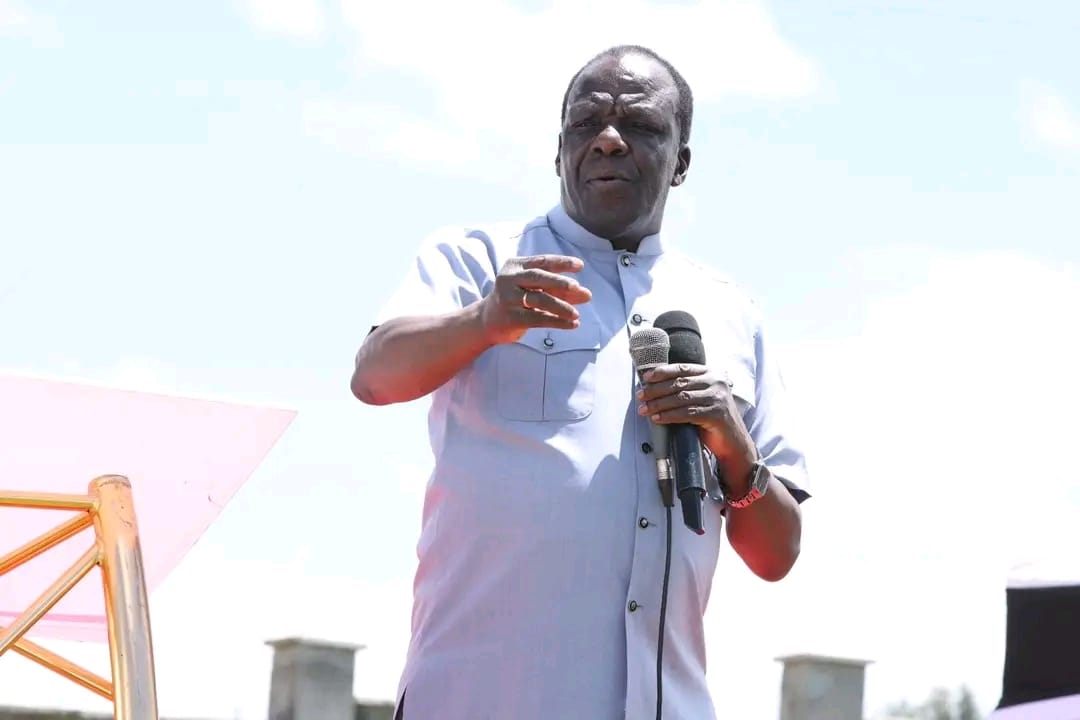
By Mercy Buyanzi -Trans-Nzoia County
Cooperatives Cabinet Secretary Wycliffe Oparanya has challenged members of Shirikiana Sacco in Trans Nzoia County to build the society into a large national financial institution capable of mobilizing savings and providing affordable capital to small businesses.
Oparanya said the idea behind Shirikiana was to bring together people from different communities and economic backgrounds and use collective savings to improve their livelihoods.
Speaking during a meeting with Shirikiana Sacco members at Sibanga in Trans Nzoia County, Oparanya said the cooperative should not remain confined to Western Kenya but expand across the country.
“I wanted to start a big Sacco here in Western Kenya, but this Sacco will not only be here in Western Kenya. It will be for the whole of Kenya,” Oparanya said.
He said the strength of a cooperative lies in bringing together many members who contribute small amounts of money, creating a large pool of funds that can subsequently be advanced to members as loans.
Oparanya cited examples of large cooperatives in other countries, saying Kenya could also develop large Saccos by embracing technology and increasing membership.
He said Shirikiana had already demonstrated potential to expand, noting that the Sacco had attracted members beyond its original area of operation.
The CS urged members to save consistently, saying collective savings could give them access to capital that would otherwise be difficult to obtain from commercial banks.
He noted that many Kenyans face difficulties accessing bank loans because they lack collateral, including title deeds for their land.
“Many of you do not have title deeds for your farms. So how will you get a loan?” he asked, arguing that cooperative societies can provide an alternative avenue for accessing credit.
Oparanya said members could build a substantial loanable fund by making regular contributions.
He gave an example of a Sacco with 100,000 members, saying that if each member saved Sh100 a day, the society could mobilise about Sh300 million in a month.
He further said that under the cooperative system, members are required to save for a period before accessing loans, allowing the Sacco to build a stronger financial base.
According to Oparanya, the model would enable members to save first, borrow later and invest the money in businesses and other income-generating activities.
The CS also urged small traders and entrepreneurs to embrace technology as part of efforts to grow their businesses.
He said the government was focusing on micro, small and medium enterprises (MSMEs), which he described as a critical component of Kenya’s economy.
Oparanya said access to affordable capital, suitable trading premises, markets and technology were among the key areas that could help small businesses grow.
He cited the Kenya Industrial Estates as one of the government programmes intended to provide financing to businesses, saying entrepreneurs could access loans of up to Sh20 million to support their enterprises.
He also said the government had developed markets across the country where traders could operate in better conditions, with facilities such as internet connectivity and storage.
Oparanya further encouraged members to make greater use of digital financial services, including mobile money and online platforms.
He said technology had changed the way people conduct business and access financial services, making it possible to save, transfer money and apply for government funds without physically visiting banks or government offices.
The CS said lack of digital skills could, however, prevent some Kenyans from benefiting from such opportunities.
He cited the Hustler Fund as an example, saying applicants needed to understand how to use digital platforms to access the facility.
Oparanya also called for stronger member education within cooperatives, saying members should understand their rights and responsibilities.
“One of the principles of cooperatives is training of members, members’ education. You should know what your rights as a member are,” he said.
He urged Shirikiana members to safeguard their savings by ensuring the society maintains proper financial management and accountability.
Oparanya said cooperative institutions should provide members with confidence that their money was secure and that they could track their savings and loans.
He also linked the cooperative movement to broader efforts to improve household welfare, identifying agriculture, affordable housing, healthcare, MSMEs and technology as important areas of economic development.
On healthcare, Oparanya said medical expenses could push families into poverty when they are forced to sell property or borrow money to pay for treatment.
He urged members to prioritise health-related financial protection and plan for unexpected expenses.
Oparanya said Shirikiana Sacco could play a role in helping members address some of these economic challenges by promoting savings, access to affordable credit and collective investment.

He maintained that his remarks were aimed at encouraging members to understand how cooperatives could improve their economic wellbeing rather than engaging in politics.
“I have come here not for politics. I am saying things as they are. When it is time for politics, I will come back and talk about politics,” he said.
Oparanya said he had spent more than two decades in politics and government and urged members to assess leaders based on facts and their record rather than relying on misinformation.
He challenged Shirikiana members to take advantage of the cooperative model to build a stronger financial base and expand the society beyond its current membership.

